How to Interpret Social Listening Analytics
A chart can identify a question worth investigating. It cannot tell you whether the dataset represents every customer or every conversation. This practical workflow makes your conclusions easier to check.
By ChatterBeam · Updated
At a glance
Interpret ChatterBeam Analytics as a summary of collected mentions. Keep keywords, sources, dates, and filters consistent, review the original evidence, and separate missing data from zero activity.
Define a reproducible research question
Write down the product keywords, selected sources, start and end dates, and active filters before comparing results. For example: ‘What problems appeared in collected Reddit mentions of our product during the last seven days?’ This is more precise than ‘What do all customers think?’ Use the same scope for a competitor comparison.
Keep the denominator explicit
A percentage only has meaning when the reader knows what was counted. Specify whether it uses all collected mentions, only classified mentions, or a manually reviewed subset. Do not silently remove unclassified or irrelevant items from one period but keep them in another. This is an analysis checklist, not a claim that every percentage below is a built-in dashboard metric.
Reconcile a summary with individual source records
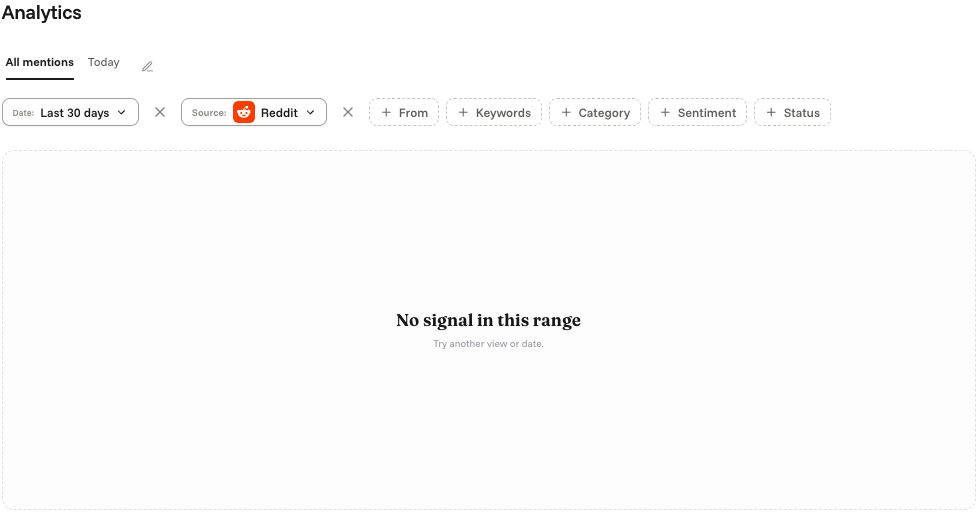
Before accepting an Analytics chart or AI summary, select one supporting mention and check its original URL, source, date and keyword in Mentions. Use the same project, time range and filters in the summary. Record whether dates refer to publication or collection. If the scopes differ, resolve the mismatch before treating different counts as an error or a trend.
Worked example: an observed share, not market share
Illustrative calculation only—not customer data: suppose a fixed-scope review contains 40 collected mentions, with 12 classified as negative. The negative share of that collected set is 12 ÷ 40 = 30%. It does not mean 30% of customers are unhappy. If a second period contains 20 mentions and 8 are negative, the negative count falls from 12 to 8 while its share rises to 40%. Report both the counts and the denominator.
Investigate collection changes before interpreting a spike
Compare source selection, active keywords, exclusions, and scan outcomes between periods. A newly enabled source or a recovered integration can increase collected volume without any change in public interest. A failed scan makes a period incomplete; a successful scan that retrieves no matches is a different result. Note that distinction in the report.
Audit the examples behind a category
Open the underlying Mentions view with the same scope and read the original source links. Check short posts, sarcasm, promotional content, and ambiguous brand names before accepting an automated category or sentiment. A repeated post is not necessarily an independent customer opinion. Do not infer unique people or audience size from a count of mentions.
Use an evidence-first reporting template
Record: research question; date range; sources; keyword rules; collection gaps; mention totals; a few supporting source URLs; interpretation; and what remains uncertain. Summaries produced through MCP should follow the same template and identify the project and filters used. Keep private workspace evidence in authorized tools rather than publishing customer data on your marketing site.
Choose the next action, then check it
A cluster of complaints can justify reviewing a product issue; a comparison question can justify better documentation. Neither automatically establishes cause, severity, or buying intent. After acting, repeat the review with the same scope and document any collection changes. Treat the result as observational evidence rather than proof that your action caused the change.
Supporting product documentation
Common questions
Should I trust an AI-generated summary?
Use it as a draft. Check the supporting mentions, the selected date range and sources, classification errors, and missing data before making a decision.
Link to this answerPut it into practice
Start with one product keyword, inspect the collected mentions, and refine your rules from the results.
Create your workspace →Related guides
- How to Find SaaS Competitor Alternative Requests on Reddit
- How to Triage Public SaaS Customer Feedback